Villain guides
The Five Villains of Low-Stakes Poker
Low-stakes poker is not one game. It is five games, one per player type across the table. Every exploit that prints money against a calling station loses money against a nit. These guides teach you to spot each type in minutes and adjust before the rake eats your edge.
More strategy guides
- Poker positions explained , a playbook for every seat at the table.
- Stack depth changes everything , short, medium, and deep stack strategy.
Same hand. Same board. Five different answers.
These are real spots from inside Poker Ascent, with the correct play for each opponent type. The numbers are not estimates. They are counted from the app's own graded answers across 13,875 drilled hands in a live $1/$2 game. Where a row reads the same across all five columns, the opponent genuinely does not matter in that spot, and we say so.
| The spot | vs a nit | vs a TAG | vs a calling station | vs a LAG | vs a maniac | Drills |
|---|---|---|---|---|---|---|
| A flush draw on the flop, facing a bet | Fold | Call | Call | Call | Call | 1,145 |
| Top pair top kicker on the flop, action on you | Bet half pot | Bet half pot | Bet pot | Bet half pot | Bet pot | 921 |
| An overpair on the river, action on you | Bet half pot | Bet half pot | Bet pot | Bet half pot | Bet pot | 671 |
| An overpair on the flop, action on you | Bet half pot | Bet half pot | Bet pot | Bet half pot | Bet pot | 617 |
| Top pair top kicker on the turn, action on you | Bet half pot | Bet half pot | Bet pot | Bet half pot | Bet pot | 616 |
| An overpair on the turn, action on you | Bet half pot | Bet half pot | Bet pot | Bet half pot | Bet pot | 610 |
| Top pair top kicker on the river, action on you | Bet half pot | Bet half pot | Bet pot | Bet half pot | Bet pot | 523 |
| Top pair top kicker on the flop, facing a bet | Call | Raise | Raise | Raise | Raise | 450 |
| Top pair top kicker on the turn, facing a bet | Call | Raise | Raise | Raise | Raise | 445 |
| An overpair on the flop, facing a bet | Call | Raise | Raise | Raise | Raise | 420 |
| An overpair on the turn, facing a bet | Call | Raise | Raise | Raise | Raise | 375 |
| A backdoor flush draw on the river, action on you | Bet half pot | Bet half pot | Check | Check | Check | 308 |
Two patterns run through it. The nit is the opponent you stop raising and start calling, because a tight player who keeps betting usually has it. The calling station and the maniac are the two you size up against, for opposite reasons: one cannot fold and the other will not. Learning those two habits is worth more than memorising a chart.
Before the flop, the same hand has up to four different answers.
The table above is postflop. This one is the decision you make most often, and it splits wider. These are real hands from inside Poker Ascent with the correct play against each opponent type, counted from the app's own graded answers across 2,501 drilled preflop spots in a live $1/$2 game.
| Hand | vs a nit | vs a TAG | vs a calling station | vs a LAG | vs a maniac | Drills |
|---|---|---|---|---|---|---|
| A5s | Fold | 3-bet standard | Call | 3-bet large | Call | 90 |
| TT | Call | 3-bet standard | 3-bet large | 3-bet large | 3-bet standard | 142 |
| JJ | Call | 3-bet standard | 3-bet large | 3-bet large | 3-bet standard | 137 |
| KQs | Call | 3-bet standard | 3-bet large | 3-bet large | 3-bet standard | 135 |
| AQs | Call | 3-bet standard | 3-bet large | 3-bet large | 3-bet standard | 57 |
| AJs | 3-bet standard | 3-bet standard | 3-bet large | 3-bet large | 3-bet standard | 103 |
| AQo | 3-bet standard | 3-bet standard | Raise | 3-bet large | 3-bet standard | 55 |
| AJo | Raise | Call | Raise | Call | Raise | 60 |
| 99 | Call | Call | Call | Call | Call | 185 |
| 88 | Call | Call | Call | Call | Call | 130 |
| 77 | Call | Call | Call | Call | Call | 122 |
| T9s | Call | Call | Call | Call | Call | 50 |
A5s is the whole idea in one line. Fold it against a nit, three-bet it big against a LAG, and just call against a station or a maniac. One hand, four different correct answers, decided entirely by who is across the table.
The bottom four rows matter just as much. Against 99, 88, 77 and T9s the opponent does not change your play at all, and pretending otherwise would be the easiest way to lose your money. Knowing which decisions are opponent dependent is most of the skill.
Which opponents play alike depends on the street
Before the flop, a TAG and a maniac take the same line, while a LAG and a calling station take another. After the flop it regroups: the TAG now plays like the LAG, and the station plays like the maniac. So 'these two opponents are the same' is only ever true on one street at a time, which is why a single label for a player is not enough to play back at them.

How to Beat a Calling Station
They never fold. Stop trying to make them.
Read the guide →
How to Beat a Nit
Their bets are always real. Their folds are your income.
Read the guide →
How to Beat a TAG
The solid regular. Beat them at the margins.
Read the guide →
How to Beat a LAG
Pressure is their weapon. Position and patience are yours.
Read the guide →
How to Beat a Maniac
Let them hang themselves. Your only job is holding the rope.
Read the guide →Go deeper
The Calling Station
The LAG
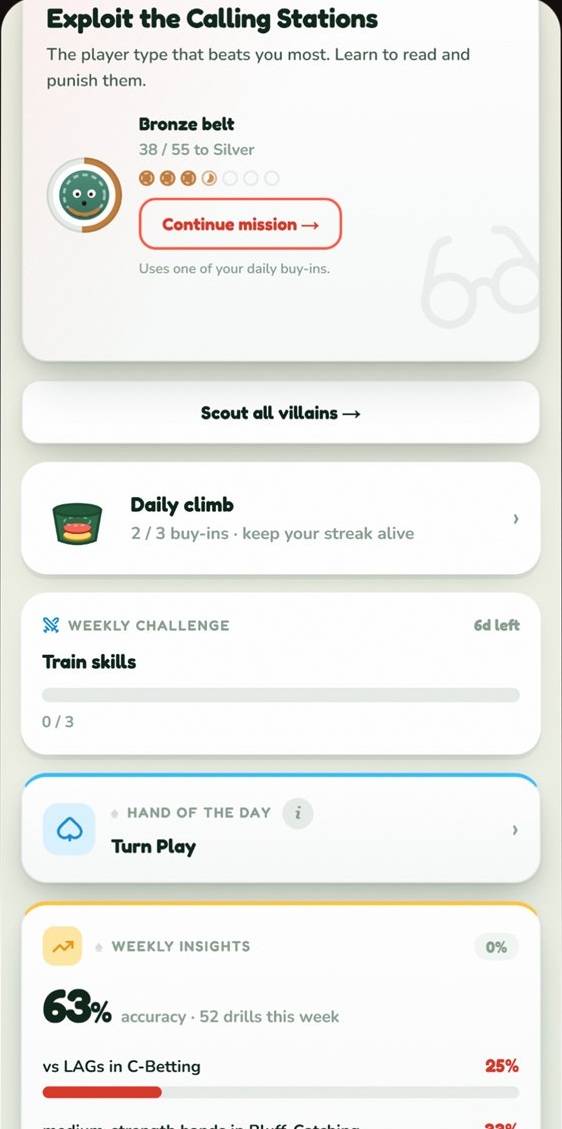
Every villain has a mission.
Hundreds of drills per player type, graded against exactly the opponent you're facing.

 Coming soon
Free on Google Play. 3 buy-ins a day, no card required.